“Words change Worlds”
.
Back in my Junior High School days, my friend recommended a book series to me, it was entitled “Percy Jackson and the Olympians”. That was the starting point wherein I was so into Greek mythology that I’ve done minor research about it. Tenth grade then came and our teacher unraveled the story of the two world renowned works of Western literature: The Iliad and The Odyssey, which was written by the famous legend in all ancient Greek Literature, Homer. Everything in those books are the main factor for my love for literature. And now having to think about it, hypothetically, if both the Iliad and the Odyssey was never written in any form, but was only spoken by mouth, would the story still be alive and influence more students like me? Would the story still be the same and flip one’s life like how it did to mine?
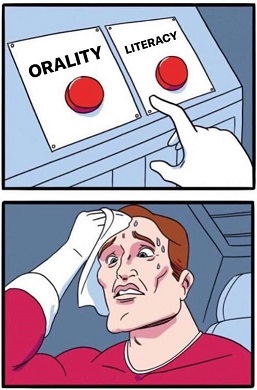
Orality and Literacy both play a major role in our history and even in our modern lives in terms of communication. Both may play a major role but they have to play their own roles.

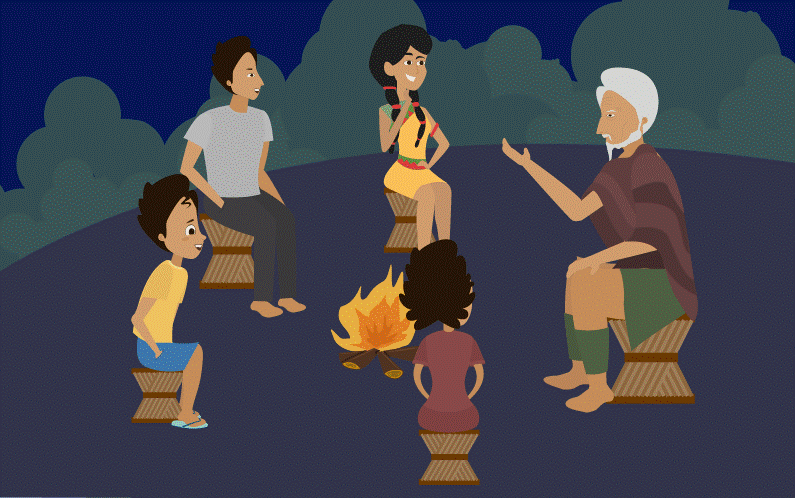
Starting off with Orality, stories by mouth was the trend before during the Paleolithic or Old Stone years. But do we have records of these stories? Are they still being spoken of? Orality’s cons are: the need to clearly hear the story, to memorize each happenings (because even minor errors can change the whole flow of the story) and even according to Walter Ong, “Orality is not an ideal, and never was” because it does not have any permanent account to hold on to. However, what keeps the oral culture alive is that some still prefers listening than reading. And who brings books during campfires to read chapters 1-10 of their favorite novel? Gestures and facial expressions makes the stories feel real and alive. Although, due to the emergence of advanced technologies, Orality is withering away over time, and oral stories with no form of writing would soon disappear leaving no trace behind.
Now, talking about Literacy. Written works won’t fade that easily due to the record it keeps, especially now that we get to have easy access to books online. Imagine Plato having no records of his writings, and no record of his being (even Socrates because we knew him thanks to Plato), will we even reach this state of consciousness? If Historians didn’t write the happenings in their times, we’ll have no proof of them happening (here now enter the old saying “To see is to believe”). Also, written works are more elaborate and precise because grammatical errors are fixed, redundancy is not needed and linguistic structures are enough to state what one means .
Even so, with both their differences we must never deny the existence of one. Let’s put into mind that both are dependent on each other, because no oral culture would not want to achieve a literate society (Ong, 1982, 2002) and written works emerged due to oral aid. People before may have passed down to generations their oral tradition, however, with our technology nowadays, it’s more convenient to spread to wider audience their oral works through literacy. Also, the preservation of the oral tradition can be put to work through literacy, helping the old works still be reached by the present generation and even the future ones.
Therefore, Orality is giving information through speech while literacy is through written works. Literacy emerged from Orality, and Orality is preserved through Literacy.
_______________________________________
Good communication is the bridge between confusion and clarity.
–Nat Turner

Communication process consists of a sender and a receiver of a message that can be both of the given role. Here is where intersubjectivity enters the picture. Intersubjectivity is the sharing of experiential content (e.g., feelings, perceptions, thoughts, and linguistic meanings) among a plurality of subjects. (Zlatev, Jordan & P. Racine, et. al.,2008). Here is an example, imagine your crush telling you that a specific painting is beautiful, with his influence you then answer that it is indeed “beautiful”.
What makes media different from communication? Well let’s start with the fact that you can never send your response to the people inside your own television, they may send their message to you but then again, you can’t give them any feedback. And as Walter Ong said, “To speak, you have to address another or others.” Which means, communication is where a human that speaks needs another human.
In conclusion, even if both of them have a sender and a receiver, in communication there must be a given response, while in media no response will be given at all.
_______________________________________
Chirographic conditioning is a method of spreading information through written works or printed text. This method is shown in media models such as novels, magazines, newspapers, etc., which are all considered still as a one-way process of communication.
It still resembles the media model because as Ong stated, “The writer’s audience is always a fiction”, meaning that the desired message that the writer wants to disseminate is being received by no definite audience or is factious. Likewise, chirographic works sends its desired message to its fictious readers with no chance of getting any feedback. Sounds familiar?
Thus, Orality and Literacy play major roles in the nature of communication. So we should bear in mind that our WORDS, no matter what form, can affect our WORLD.
_______________________________________
References:
- Ong on the Differences between Orality and Literacy. Retrieved from
http://newlearningonline.com/literacies/chapter-1/ong-on-the-differences-between-orality-and-literacy - Ong, Walter J. (2002). Orality and literacy: The technologizing of the word.
London: Routledge, Taylor & Francis Group. - Zlatev, Jordan & P. Racine, Timothy & Sinha, Chris & Itkonen, Esa. (2008). Intersubjectivity: What makes us human?. The Shared Mind: Perspectives on Intersubjectivity.
 Rachell Anne T. Capaning