Featured

Orality and Literacy affecting the Nature of Communication

“Words change Worlds”

.

Back in my Junior High School days, my friend recommended a book series to me, it was entitled “Percy Jackson and the Olympians”. That was the starting point wherein I was so into Greek mythology that I’ve done minor research about it. Tenth grade then came and our teacher unraveled the story of the two world renowned works of Western literature: The Iliad and The Odyssey, which was written by the famous legend in all ancient Greek Literature, Homer. Everything in those books are the main factor for my love for literature. And now having to think about it, hypothetically, if both the Iliad and the Odyssey was never written in any form, but was only spoken by mouth, would the story still be alive and influence more students like me? Would the story still be the same and flip one’s life like how it did to mine?
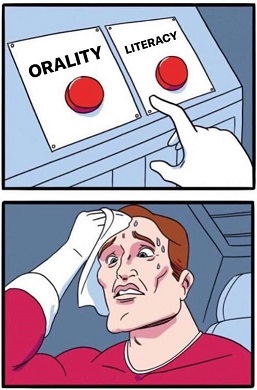
Orality and Literacy both play a major role in our history and even in our modern lives in terms of communication. Both may play a major role but they have to play their own roles.

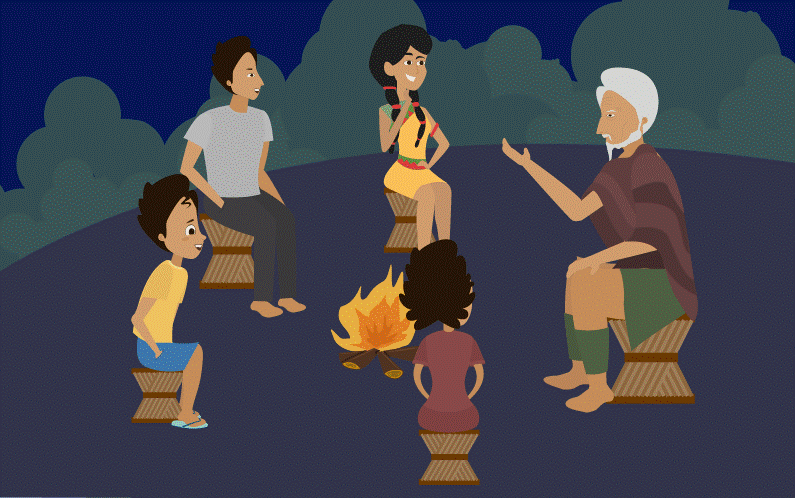
Starting off with Orality, stories by mouth was the trend before during the Paleolithic or Old Stone years. But do we have records of these stories? Are they still being spoken of? Orality’s cons are: the need to clearly hear the story, to memorize each happenings (because even minor errors can change the whole flow of the story) and even according to Walter Ong, “Orality is not an ideal, and never was” because it does not have any permanent account to hold on to. However, what keeps the oral culture alive is that some still prefers listening than reading. And who brings books during campfires to read chapters 1-10 of their favorite novel? Gestures and facial expressions makes the stories feel real and alive. Although, due to the emergence of advanced technologies, Orality is withering away over time, and oral stories with no form of writing would soon disappear leaving no trace behind.

Now, talking about Literacy. Written works won’t fade that easily due to the record it keeps, especially now that we get to have easy access to books online. Imagine Plato having no records of his writings, and no record of his being (even Socrates because we knew him thanks to Plato), will we even reach this state of consciousness? If Historians didn’t write the happenings in their times, we’ll have no proof of them happening (here now enter the old saying “To see is to believe”). Also, written works are more elaborate and precise because grammatical errors are fixed, redundancy is not needed and linguistic structures are enough to state what one means .

Even so, with both their differences we must never deny the existence of one. Let’s put into mind that both are dependent on each other, because no oral culture would not want to achieve a literate society (Ong, 1982, 2002) and written works emerged due to oral aid. People before may have passed down to generations their oral tradition, however, with our technology nowadays, it’s more convenient to spread to wider audience their oral works through literacy. Also, the preservation of the oral tradition can be put to work through literacy, helping the old works still be reached by the present generation and even the future ones.
__

Therefore, Orality is giving information through speech while literacy is through written works. Literacy emerged from Orality, and Orality is preserved through Literacy.

_______________________________________

Good communication is the bridge between confusion and clarity.
–Nat Turner

Communication process consists of a sender and a receiver of a message that can be both of the given role. Here is where intersubjectivity enters the picture. Intersubjectivity is the sharing of experiential content (e.g., feelings, perceptions, thoughts, and linguistic meanings) among a plurality of subjects. (Zlatev, Jordan & P. Racine, et. al.,2008). Here is an example, imagine your crush telling you that a specific painting is beautiful, with his influence you then answer that it is indeed “beautiful”.

What makes media different from communication? Well let’s start with the fact that you can never send your response to the people inside your own television, they may send their message to you but then again, you can’t give them any feedback. And as Walter Ong said, “To speak, you have to address another or others.” Which means, communication is where a human that speaks needs another human.

In conclusion, even if both of them have a sender and a receiver, in communication there must be a given response, while in media no response will be given at all.

_______________________________________

Chirographic conditioning is a method of spreading information through written works or printed text. This method is shown in media models such as novels, magazines, newspapers, etc., which are all considered still as a one-way process of communication.

It still resembles the media model because as Ong stated, “The writer’s audience is always a fiction”, meaning that the desired message that the writer wants to disseminate is being received by no definite audience or is factious. Likewise, chirographic works sends its desired message to its fictious readers with no chance of getting any feedback. Sounds familiar?
Thus, Orality and Literacy play major roles in the nature of communication. So we should bear in mind that our WORDS, no matter what form, can affect our WORLD.

_______________________________________

References:

Getting to know Semiotics

Ever wonder how we get to analyze images and make meanings from our perceptions? How we hear the sound of the ambulance and know there’s an emergency nearby? Or how we associate the color yellow to a banana to its ripeness? Here is where Semiotics enters the picture. What is Semiotics? It is a field of study that examines signs, symbols, and such to interpret the world revolving around us, as well as produce meanings from these signs.

Signs in Semiotics can be anything or an object that represents something else than itself. For example, if I show my friend a picture of my cat, I am giving her an idea of what my cat is without personally showing her my cat. No matter what it is, a realistic painting, hand-drawn picture, or even just the word “cat”, it could still be called a sign because she’ll still get the idea of the cat without an actual cat.

Studying Semiotics is relevant and useful in the world of representations because having our perceptions as a vital factor in mutual understanding. A lot of issues and drawbacks can happen when one misunderstands the meaning of shown signs and symbols. For example, when we do a peace sign, here in the Philippines it only means peace or even sorry, but in other countries specifically in England, if you do the peace sign backward, you’re already flipping someone off. In giving meaning to verbal and non-verbal signs and symbols, we can have different understandings and perception, therefore, it is important to study Semiotics.

To articulate my understanding of the given reading better, below is a glossary of important terms to remember when studying Semiotics:


Signifier – the physical representation of a thing. It can be seen, touched, heard, tasted, or even smelled. It is the carrier of meaning.
Signified – the mental representation of a thing. It is an idea that we, the communicators are trying to evoke. It is the meaning we correlate the thing with.


Paradigm – a set of associations that bears a vertical pattern where order doesn’t matter.
Syntagm – a set of signs that bears a horizontal sequence where order does matter.


Iconic – a sign that bears resemblance to its object or to what it represents.
Index – a sign that has a link to its object or to what it represents by direct relation or causal link.
Symbolic – a sign that bears no inherent relation between the signifier or signified, other than the fact that we have decided to link them to its object.


Myths – a potent way of making meanings in society. A sign that bears a second-order signification because its meaning can be produced from values of the dominant value system – or ideology – of a particular society and make these values seem natural.
Binary Opposition – signs that don’t have an inherent meaning but are defined by another sign – a sign that’s opposite to it. 2 contrasting elements that are defined by each other.

Bravest Warriors: Overseas Filipino Workers

Oftentimes, Overseas Filipino Workers are seen as people growing trees of money whilst picking from it. However, has it ever crossed our minds how much they’re suffering every day? How every breath, sweat, blood, and tear shed and have dropped from their bodies is equivalent to a leaf from THAT tree?


Growing up not having my father with us 24/7 (He went to Dubai by the year 2006 to work for a construction agency), I could say how hard it was for him and us. A lot of times as a child, I would be crying whenever we talk online, hoping he would come home any minute to wipe my tears. I questioned how come he hasn’t come home yet? Why can’t he just work here in the Philippines? I was so jealous of my friends because their fathers work here in the country and have the chance to go home every day or even twice a week, but then as a child, I didn’t know much about how the world worked so my father had to explain our situation again and again. I was missing him but he was missing us more, and I failed to see that. Then when I began to wake my eyes about the real world, I realized that it isn’t easy here in the Philippines. Due to lack of employment, and salaries are far more times less than foreign salaries that it won’t be enough to raise a family to breathe lightly.


Upon seeing the documentary, the prick of a thorn in my heart became wider for OFWs, especially for my father. I’ve realized how much I’ve been insensitive toward how my father feels. We tend to ask much from them like a new pair of shoes, branded clothes, and gadgets as if they’re millionaires that we forget about their struggles like sleepless nights, missing the essence of home, craving for the warm hug of their family, and as seen from the movie – mistreatment of their employers (except for those who got lucky).


It was also depressing to see that these “Sunday Beauty Queens” are our modern “Cinderellas” because they are slaves most of the day and only get to enjoy, be themselves, and feel beautiful for a couple of hours, and when the clock strikes 12, they go home to their respective places and be maids again. Why is our government doing so little in helping our OFWs when in fact they contribute most to our economic stance?


As seen from the movie, one domestic helper missed her son’s graduation march because she can’t go home to attend such memorable event, and I felt so much sympathy for her because like my father, he too was not able to witness me march, go to the stage and pin my medals to me (Elementary to Senior High School). My father missed tons of important life events – birthdays (even my debut), graduations, also funerals of his loved ones and friends, all due to work. When will the day come wherein parents don’t miss any single event with their families? Because we know as ancient as it is “Time is Gold”, therefore must not be wasted. Therefore, when? When will this precious time be spent with their families than with co-workers? When will our 24/7 face-to-face interaction happen than mere video calls?


Sunday Beauty Queen called out many important points and it showed a lot about our reality and theirs(Domestic Helpers). We have always thought that the bravest profession is being in the military, but never did it cross our minds the courage our OFWs (more importantly our Domestic Helpers) hold. Though no profession should be above and below others, I still hold my opinion that the bravest warriors are those who wear the armor of courage, the shield of love, and the sword of persistence – the OFWs.

Reaching Unity through Diversity

Now that we are in a diverse era, for us to reach a common ground in integrating economies, industries, markets, cultures, societies, and policies around the world, we need to negotiate with each other, compromise, and make adjustments. When we reach a point of understanding, we are in a place not seen by the naked eye called Third Space.

The ‘third space,’ a term originally coined by Homi K. Bhabha (1994), it is a concept used to describe the possibility for a negotiated re-imagining of cultural identity. It is where we negotiate identity and become neither this nor that but our own. The word “Third” holds the connotation of being in a mediated space where there is a process of construction and reconstruction of identity.

The movement towards third space impacts an intercultural encounter in the sense that it paves the way for different cultures to have an objective understanding and settlement. To cite an example, when President Xi Jinping and Indian Prime Minister Narendra Modi met on October 12, 2019, in Chennai, India, wherein they exchanged views in a candid and in-depth manner about China-India relations and major international and regional issues of common concern. Though China and India are somehow antonymous in terms of their culture, religion, language, and even in their economic stance, they were still able to enhance mutual understanding, formed clearer goals and ideas, and maintain stable development of bilateral relations.

According to Fred L. Casmir there are eight primary qualities for the third culture building (TCB) framework to be successful. First, TCB is an organic “bottom-up” and emergent practice, which means, members should recognize the factors first to co-create interactional environments that are relevant for each. Second, TCB provides users with a general framework for engaging in communication, participants are required to be attentive to the process and any changes that may occur (Casmir, 1999). Third, TCB is an egalitarian approach rooted in the ideals of fairness and democracy. Meaning, members must view each other as fair, democratic, and equal individuals. Fourth, TCB requires self-knowledge and/or self-discovery, and knowledge of one’s communication partner. We should first take an interest in knowing our own culture for us to be open with other cultures. Fifth, TCB is both conscious and deliberate. This means that members should have mutual efforts in the process of achieving common ground. Sixth, TCB is based on proactive action. Members must compromise, make adjustments, and have a problem-solving approach to communication to avoid conflict and unwanted problems. Seventh, TCB framework imagines possibilities for positive outcomes. Members must have an agreeable and fit all needs and situations. Eighth, TCB requires time. We cannot obtain a third space by night, and because of its complexity, it requires patience and time.

The process of reaching third space can be complicated, but it’ll be worth all the effort in the end.

Filipi-Know Your Way

We Filipinos have our own ways of having interpersonal communication with others, and Melba Maggay, in her book “Pahiwatig: Kagawiang pangkomunikasyon ng Filipino”, compiled and chose 10 common grounds of how we engage with such communication. Such as: Pagpapahiwatig, Mensaheng may Tagapamagitan, Pagbubunyag, Pagpapakitang-Giliw, Paglalantad ng Sarili, Tuwirang Pagsasagutan, Pagsisiwalat ng mga Pansariling Impormasyon, Pakikipag-Sosyalan, Pagbibigay ng Balita, and Katutubong Retorika.

To dig deeper, let’s define each one of them.

Pagpapahiwatig, is communication through indirect manner which are used commonly if the message can be triggering or offensive. Mensaheng may Tagapamagitan, is communicating with a mediator to avoid further conflict. Pagbubunyag, is the idea of being open or disclosing information, feelings, issues, and such. Pagpapakitang-Giliw, is putting one’s best foot forward always. Paglalantad ng Sarili, is the idea of showing off. Tuwirang Pagsasagutan, is communication through argumentation but in a formal manner. Pagsisiwalat ng mga Pansariling Impormasyon, is spreading information even if it is a private matter. Pakikipag-Sosyalan, is the idea of socializing in order to gain information. Pagbibigay ng Balita, is communicating through spreading news for the large audience. Katutubong Retorika, is the traditional way of communication through discourse.

Being in a society where communicating is a way of socializing, I feel like these 6 ways: Pagpapahiwatig, Mensaheng may Tagapamagitan, Pagbubunyag, Tuwirang Pagsasagutan, Pakikipag-Sosyalan, Pagbibigay ng Balita, are the ways I’m most accustomed with. Pagpapahiwatig – because I am somehow a person that likes to keep things to herself, especially when I’m mad. I am not a direct person, because people needs to push me more to be open or to share my feelings, and I just give hints or clues to people of how I’m feeling. Mensaheng may Tagapamagitan – because as I have said. I am not a direct person, that I need someone to even say things in my behalf. For example, when I want something or need something, I’ll ask my mom to tell my dad what these needs are. Pagbubunyag, though I am a book with glued pages, I still open up to some, to my intimate friends only, those who are really close to me, and those who I have seen that’s worth my trust. Tuwirang Pagsasagutan – I argue only when I know I am right, and though I don’t always argue, it is because I keep in mind that “It is better to say nothing than say something unnecessary and irrelevant”. Pakikipag-Sosyalan – I like socializing and meeting new friends, because why not right? and lastly, Pagbibigay ng Balita – because my mother isn’t much of a “tech-y” person, I tell her news that are trending in any social media platforms and that I also bring news to my friends and relatives.

Though most of these ways are positive, we can’t deny the fact the we Filipinos are implicit for we have a high-context culture of communication, that is why problems will arise. To state some, the high probability of misunderstanding, because we Filipinos have the tendency to beat around the bush when we can just state our point briefly. Also, having misleading information, because facing reality, some of our neighbors are good story makers and comprehensive authors, that they have the ability to create stories and tell the tale through tsimis. And lastly, loss of one’s privacy, because when information are already disclosed, people will be talking about it and even have a tendency to add spice to it, destroying one’s privacy and image.

In addition, not only these are prevalent on face-to-face communication, but also through online interactions. Now that social media is commonly used by not only the teenagers, but also the adults as way of checking up on the people around them, these observed ways by Maggay is visible. For example, Paglalantad ng Sarili, some people (for the purpose of not generalizing) posts unnecessary things on Facebook, like their meal for the day, their new clothes and jewelry, and anything they could show off and impress others. And even Pagpapahiwatig is visible, like how some posts in their timeline some quotes or photos with captions that is meant for one person but is too scared to tag them and or give recognition.

Even if these ways are prevalent in us Filipinos, I cannot actually claim that it is innate in us Filipinos because some countries hold these too. I also think that these ways are formed due to socio-historical factors, because being colonized by tons of colonizers for a very long time, we became adaptive to the culture. Like how plans for war were made underground or secretly for the fear of being caught. News was also spread to awaken the hearts of the Filipinos to fight against the discrimination and oppression that time, and more.

Although Maggay and Lacson’s observations are somewhat similar, in terms of, having people share and spread information and meddle in individual or private matters, Lacson’s research is more focused on the negative side of the Filipino Communication Culture, and we should never just settle on the negative side, that’s why Maggay opens new avenue for a wider understanding of us Filipinos, because in understanding, brings our identities. That’s what we should know, right Filipi-know?

What’s your favorite position?

“The self is constantly under-construction by the society, molded by social interactions and environment”, I’ve stated this in my last blog which is also relevant in this one.

In Eleni Andreouli’s “Identity, Positioning and Self-Other Relations”, there were two conceptualizations of positioning that was analyzed. The first one was about the social representation theory which talks about how social representation “provides various possible identities which allow people to position themselves in a variety of ways in relation to the symbolic field of culture”, as stated by Gerard Duveen. Second, is the positioning theory, that states “the discursive process whereby people are located in conversations as observably and subjectively coherent participants in jointly produced storylines”.

To dig deeper, positioning theory is the construction of identities by communicating. For example, I am a student here in UP, and whenever I talk to others, like uneducated people, my relatives, and neighbors, and they would ask which college or university I go to, I’ll answer them “Sa UP po”, and they’ll either look astonished or disgusted. Why? Astonished because they’ll say “All the students there are intellectuals”, and disgusted because they see me as “Potential NPA”.

Another evident example is when I met my aunt that I haven’t seen for years, she asked me which college I’m in, and when I said UP, she replied “Your teachers teach you how to be activists right? Don’t let them get into you, or else you’ll be an NPA like as seen in the news”. Still bearing respect, I responded ” No Tita, our teachers don’t even care about our political propaganda and views, all they do is teach us how to be critical thinkers to be able to stand up for the oppressed. We are being taught to be FOR the mass, not AGAINST the mass”. I left her with an excuse that I need to go to the bathroom.

This just proves that collective identities create problems among other identities, like stereotyping, prejudice, and discrimination. But always remember, when there are problems, there are solutions.

To state an example of a marginalized group, the all people in jail are being stereotyped and generalized as as monsters and guilty of their crimes, when in fact some of them are just victims of injustice and other factors like, being paid as a stand-man for the real person who committed the crime, or not being able to win the case due to lack of money. These people, even though they do get out of jail, people will still see them as monsters as they are because of the stereotype and nameplate they’ll always carry. This would result in them not being accepted for jobs, and not being given the voice they need. This is why some of them go back to their old ways and even prefer to go back to jail wherein they could at least eat a meal a day and have a livelihood.

How do we converse with them when in the first place we take their ability to speak for themselves? How do we break the stereotype made by society to their collective when we don’t go the extra mile of lending our ears?

People who are marginalized like them need to be heard. They need to fight for what’s left of them – their own identities. They need to rise against what society tells them.

In addition, being a UP student, I have an issue of how society tries to silence me and students like me, as well as tag me as an activist or “potential NPA”. However, I won’t just concur and let them continue with their stereotype “naivete”. I am choosing my position, I am destined to serve THE people, and not AGAINST the people.

Are you being stereotyped? Then answer this, what would be your position?

Self: A Kaleidoscope in the Making

A wise philosopher once said, you can never step on the same river twice and that the only thing that does not change is change itself, and in relation to that, our self is in a constant spiral that’s open to possible changes, let it be through experiences or through human intervention, for we humans are an unstable ball of beings. To question and wonder is a nature of man and one who does not question is less of a man, that is why I have number of questions that are difficult to answer, to state one -“Who am I?” Isn’t it too broad and at the same time cliche? Because let’s face the fact, certainty is temporary and when you reach a certain answer to your identity, changes could come and make you go back to square 1.

Mokros stated that “identity is constituted by self reflection of discourse and interaction. Which means that the self is constantly under-construction by the society, molded by social interactions and environment. We are in a never-ending process of construction through interactions, and that the “self” is both from the upbringing of an individual and the society.

How does communication construct one’s identity? According to Michael Hecht and his colleagues, in their theory – Communication Theory of Identity”(CTI), “humans are inherently social beings whose lives revolve around communication”, and it speaks volumes due to the fact that the main medium to socialization is to communicate to another individual, and to the community. How do we interact? By communicating. How to get to know another individual? By communicating. In any form of interaction, communication is key. That’s why when one’s identity is being formed, interaction is needed and by interaction – communicating.

Talking about the framed or layered perspective, it is stated as ” identity as multifaceted”. Because the “self” has multiple “center” of identities, the CTI condensed it to 4 frames, that includes, personal, enacted, relational, and communal frames. The first one is personal frame talks about the self and one’s self-concept, from the word it self personal. It is the analysis of one’s self, characteristics, and such. It is also how one individual discerns the self.

Second is the enacted frame, being self explanatory, “to act out”. It is stated in the theory that it is the performance or expression of identity. Communication for example, when we exchange enacted expressions and such. As stated earlier, communication is one of the key factors that molds one’s self.

Third is the relational frame, which is broken down into 4 levels. The first level is where we define ourselves according to how others perceive us, or also known as ascribed relational identity. Second level is how an individual forms the self through the relationship with others, like friends, relatives, loved ones and others. Third, how our identities exist are shaped through other people’s identities. Lastly, an identity molded by a relationship itself.

The fourth frame is the communal. It is the identity that formed by the community, group, or the collective.

Though others may say that these frames are different, but in fact they can be interpenetrated. To be clearer, as an example, when I question myself for being religious (personal frame), I will look at my roots, my parents and family members and ask them why (relational frame) as well as observe what they do and how I’ve come to be religious (enacted frame), lastly, question my peers and social groups and observe them as well (communal frame). And all of these requires communication.

Another way for these frames to interpenetrate – dialectical tensions. It is where though these frames differ and contradict each other, they could still coexist and permeate due to the dialectical tension among them. This tension as stated in the CTI “source of the dynamic and fluid nature of identity”. And due to the issue of discrepancies of the frames, and imperfectness of communication, Identity gaps came to life.

To be able to really understand this, here is an example of mine.

When I’m ask to describe myself, I would say that I’m a religious person because I’ve spent my education years in a Catholic school, I’ve done services for the church and in the church, and I’ve joined communities or church groups that devotes ourselves to the Supreme Being and the church, however, due to my actions and vocal expressions, people perceive me as a “little ball of evil”, without thinking that this identity of mine is caused by my interactions with them too.

Therefore, no matter how much we claim that we are unique individuals and that we are not photocopies of the society, we’ll always return to the mere fact that the person we are today is influence by factors like religion, culture, environment, media, and such. We may not see the way they’ve affect us, or the changes they’ve caused us, we can’t deny that these things happened

In addition, there may be times that we feel like we are not ourselves anymore or we don’t act the way we used to, let’s just remember that the self is in a constant construction, that it adds another hollow block and cement every time and that’s okay. We are unstable beings so we should accept instability. We are a kaleidoscope, and that’s what makes us beautiful species.

Let’s go Digital!

Being at the peak of innovation, everything is just one click and swipe away. Need to know something about our history? Google it. Need to know what’s trending? Go to any social media apps like Twitter, Facebook, Tumblr, and such. Everything is so convenient now that people take technology for granted and forget the main objective of this wonderful innovation.

“Everything changes but change itself”
-Heraclitus

Back in the days of Socrates, Traditional Rhetoric was the thing, where the Sophists would discourse and persuade through oration in front of the crowd. Now I’m not saying that it was not effective because it was, but there is always room for improvements right? This is where Digital Rhetoric takes place. What is Digital Rhetoric in the fist place? To simply state it, it is using the modes of Traditional Rhetoric in digital platforms, let it be through videos, photos, arts, written articles, and more. But let’s dig more unto it, shall we?

Facebook and Twitter are one of the main sources of information by the youth and even the adults, due to its accessibility, everyone has an equal chance to voice out their opinions and insights about a specific exigence, now let’s put into mind that again ANYONE HAS THE EQUAL CHANCE TO STATE THEIR OPINIONS, so whether what that person post is factual or not, he or she can still post and persuade uninformed individuals.

One example is Mocha Uson’s Blogs, her being a public figure makes her influential and that a lot of citizens can see her posts, and I have read her writings and it saddens me that there are a number of people who actually believes what she says when since day 1 she has been spurting nonsense and non-factual based arguments. People has been agreeing and sharing her posts that resulted to a spider web effect, that makes the uninformed vulnerable.

What makes Digital Rhetoric stronger than the Traditional? Gurak stated that characteristics such as speed, reach, anonymity, and interactivity are the advantages of being rhetoric online. Speed, it is more convenient to persuade online because you can just post in any digital platform like Facebook, Twitter, Reddit and like this one – WordPress. Reach, again being in a digital world, your post could reach thousands, or even millions of people in a wider range – different countries and all. Anonymity, you could also get the chance to stay anonymous to avoid threats or if you don’t like to gain any recognition. Lastly, interactivity is being closer to the people because you get to interact and have discussions with them even if they are a thousand miles away from you. Traditional Rhetoric may be successful in persuading, but nothing must stay the same, to achieve greater things, one must evolve.

According to B. J. Fogg, “computers functions as a persuasive technology”, for it is an easy access tool to persuading the mass. Even without us noticing, we are being persuaded by what we see online, and because we are in a constant conversation with human beings, in Twitter we get to see people’s replies about a certain topic and in Facebook we get to see people’s comments, which can lead to reflect and soon be persuaded.

For example, a product of the Lotus MarketPlace was never put in business because of some issued raised about it, even if it only came out due to “highly emotive and inflammatory ethos”. If people didn’t persuade and didn’t get persuaded, this product could be making tons of money by this time.

Warnick stated that “symbolic action as carried out through visual images, specialized argots, hypertext patterns” – the digital world is being used in the process of creating an identity and a community. How? And how does it affect one’s rhetorical practice?

To make things a lot clearer let me state an example. I am born and raised Catholic, I follow pages in Facebook and accounts in Twitter that, of course teach and preach about the church. Now here comes the issue about the implementation of Divorce, and me being formed by a community that values the sanctity of marriage in accordance to the Scriptures, I chose the side of defending the sanctity of marriage by not implementing Divorce in the Philippines, and that I made a rhetoric response to a post about Divorce out of rage. I then read the comments about my response, some agreed and some chose the other side. It made me think about the argument of the other side and at the same time how I too became a factor of one’s formation of identity.

To sum it all up, we are in an era where we are capable of doing a lot of things. We should think about it carefully and use this ability wisely. Because our persuasion now, could lead to creating a group of individuals with the same opinions as us. Persuade responsibly.

Amazon Rain Forest Fire: Humanity’s road to Armageddon

A planet inhabited by humans, but how human are we?

The Amazon Rain Forest, also known as the “Lungs of the World”, is the vessel holding a massive amount of the world’s oxygen. The Amazon was our greatest warrior against the fight with Global Warming, for its ability to absorb carbon from the air and produce more than 20 percent of the world’s oxygen. However, last August, a drastic news was brought to the entire humankind, the Amazon was burning for weeks, and nobody was there to save it.

When the world was set aflame, everybody shunned. People was more raged by the news about the cancellation of Spider-Man by Sony due to its conflict with Disney, that it was the no. 1 trending hashtag on Twitter. The news about the burning Amazon? The #PrayForAmazon? It only came 3rd.

Forest and villages left in turmoil, a home of thousands of species, plants and the Amazonian Tribe; and the reality is that we live in a world where selflessness is a scarcity and cynicism is aplenty. Now conspiracy theorists and some scientist believed that the Amazon Fire was not due to natural events but due to the President’s own selfish motives.

Brazil Tops Again! – Brazil is considered to be the largest exporter of beef next to India, that their level of beef production is at 9.9 million metric tons per year. Now rumor has it that this could be the main reason why the Amazon is burning, to have larger pastures and have an increase of their cattle production. And I do agree about this, because selfishness is what drives a human to go beyond this level of evilness.

But what makes it sad? Rumors are nothing but rumors until proven true, and what proof do we have to accuse those people in well tailored suits, guilty? What power do we have to stop them?

Nature has always provided us with more than what we need. Nature let us have the innovation we desired even if it meant losing parts of herself. We took more than what we need, but again, Nature never bat an eye. And now, when Nature started to cry, humans went to slumber.

I am just a mere student with nothing but just my words, my voice. All I could do is be heard, tell stories as this one, spread awareness, and maybe provoke the hearts of the believers and fight against this exigence. For the people who has the chance, the power, and the potential to do something, have shunned and closed their eyes for our Nature’s outcry.

All I could say to Nature is, forgive us Mother for we have sinned. If destruction and death is what awaits us as your revenge, it will be a bitter pill but we could only do much – to swallow.

Wanna change the world? Try being rhetoric.

“I think the power of persuasion would be the greatest superpower of all time.”

– Jenny Mollen

A person who’s good at rhetoric has the ability to persuade, ability to make falsity sound like the truth, the truth to falsity, and has the ability to change the world. This is why during the time of Socrates, Sophists was the basis of law and people believed that what they say is considered the truth, because they were good at rhetoric and oration.

But how do you know that a situation or discourse is in a way, rhetoric? How do you become a rhetorician? Such questions is answered by Lloyd F. Bitzer.

Now according to Bitzer, when there’s a rhetorical situation, a rhetorical discourse follows. Let’s break that, okay? A discourse is when one responds to a situation, and rhetorical is when one asks or states something for merely being effective but doesn’t expect any respond. And again, a rhetorical situation is the context in which speakers or writers create a rhetorical discourse, as stated by Bitzer.

“The rhetorical situation may be defined as a complex of persons, events, objects, and relations presenting an actual or potential exigence which can be completely or partially removed if discourse, introduced into the situation, can so constrain human decision or action as to bring about the significant modification of the exigence” (p. 37). In layman’s term, rhetorical situations refers to a person, event, or an object that molds people’s perspectives using communication.

To analyze clearly what is rhetorical situation, here are the three aspects given by Bitzer to define such situation. 1.) Exigence, 2.) Audience, and lastly, 3.) Constraints.

First on the list is exigence. Exigence is what starts a rhetorical situation. It is the potential to have the idea of change, it is also the problem or imperfection marked by urgency. In other words, exigence is an issue or problem that demands urgent solutions or discourses. Which prompts a person to write or speak to initiate change. Which then leads us to the audience.

Audience are the mediators of change or the purpose of doing such discourse because they are being influenced by it. It takes two to tango as they say, that’s why rhetoric must have it’s receiver – the audience.

Lastly, the constraints. It is made up of persons, events, objects, and relations which have the power to constrain decision and action needed to modify the exigence. Let’s say religion, culture, society, and others are some factors that constrains change and the potential of the audience to address solutions to the exigence.

A sample issue that warrants a rhetorical situation is about the SOGIE Bill as presented by Gretchen Diez, wherein she and the people like her are being discriminated and denied access to the ladies’ restroom. With this matter being featured frequently in the news, people have been torn into different perspectives. The exigence here is the discrimination given to trans and them fighting for their rights, and the audience are us the people whose stand about the issue vary, and the constraints are fake news, religion, and people who are homophobic.

Going back to the question “how do you know that a situation or discourse is in a way, rhetoric? “, here are 2 types of situations (presented by the given videos) and let’s distinguish which situation is rhetoric and which is not.

The first video was a clip of a Atom Araulo delivering news about the super typhoon which hit the country, specifically in the Eastern Visayas on November 8, 2013 or the commonly known as the Typhoon Yolanda. Though the video was informative about the problem at hand, it isn’t rhetoric because it merely informs the audience about the issue. And as stated by Bitzer, “whatever comes about of necessity and cannot be changed — death, winter, and some natural disasters, for instance — are exigences, but are not rhetorical.” Which means, the situation didn’t need or demand any discourse or call for change for it was just informing the mass.

The second video was a clip of a Martial-law survivor and film director, named Joel Lamangan, who persuaded the audience that he’s experience during that era was gruesome and was never pleasant in any form. With him stating his youth experiences, people most especially the millennial, started voicing out their opinions about the issue. In this video, the 3 aspects of rhetorical situation are seen. The exigence here is about another Marcos gaining power and the late President Ferdinand Marcos being buried in the “Libingan ng mga Bayani”. The audience was the people who joined the rally and expressed agreement with the film director, and the constraints there was the people who stood to what they believed and was never swayed.

This is what Aesop meant when he said “Persuasion is often more effectual than force.”. The ability to be rhetoric is greatest and most effective ability to change the world. However, we should consider doing deep investigations first before persuading people, because for one to conclude, one must know the truth, and not just by mere benefits and motives. We are capable of changing the world, let’s use it wisely.

References:

Bitzer, L. (1968). From Philosophy and Rhetoric, Vol. 1. The Rhetorical Situation.

Video References:

Video 1: Storm Surge Hits Tacloban City – https://www.youtube.com/watch?v=rxmHNuky0hU
Video 2: Film Director Speaks Out in a Rally –https://www.youtube.com/watch?v=DoByGTN2dqg&t=4s

Design a site like this with WordPress.com
Get started